

The CEO Perspective (The Fixed-Cost Advantage)
How a Single Invoice Can Transform an Airline’s Training Budget
SOFIA, BULGARIA, March 2, 2026 /EINPresswire.com/ -- How a Single Invoice Can Transform an Airline’s Training BudgetBudget planning in aviation is closely linked to cost predictability. For many airlines, training expenses are distributed across multiple invoices covering individual employees, specific courses, simulator sessions, and regulatory updates. This structure can make forecasting difficult and introduce variability into cash flow management.
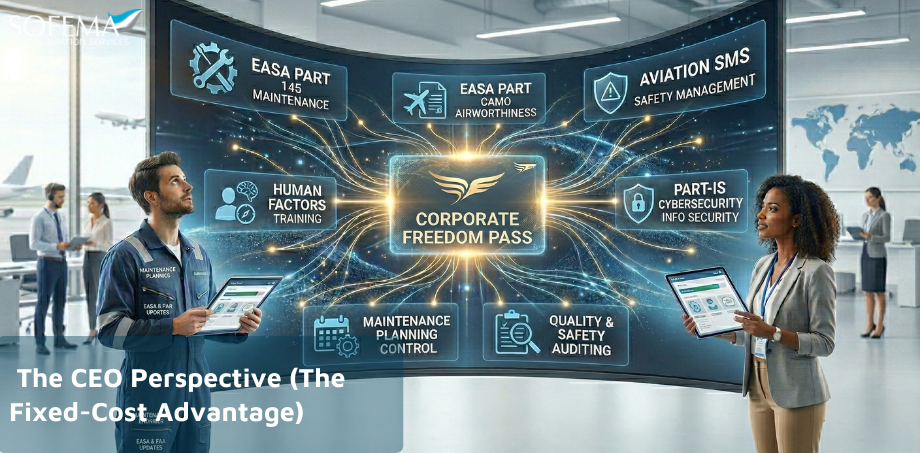
An alternative approach is based on a single fixed annual invoice covering a defined scope of training requirements. Sofema Aviation Services offers this structure through its Corporate Freedom Pass (CFP), which consolidates access to training into a single annual fee. The model is designed to provide unlimited access to agreed courses and regulatory updates within the contracted period.
Managing Training Costs Through Consolidation
Traditional training models often generate multiple transactions throughout the year. Each new hire, recurrent requirement, or regulatory amendment may result in an additional invoice. Over time, this can increase administrative workload and reduce visibility over total annual expenditure.
Under a consolidated annual model, airlines agree on coverage at the beginning of the year. The fee is typically structured according to fleet size or number of personnel. Once in place, training access is not linked to individual course purchases.
Key operational impacts reported by operators using this structure include:
> Predictable budgeting: Annual costs are defined at the start of the financial year, enabling more accurate forecasting.
> Streamlined cash flow management: A single payment replaces multiple transactions, reducing administrative processing.
> Ongoing regulatory alignment: Personnel can access required training without additional per-course charges, supporting compliance with authorities such as the European Union Aviation Safety Agency (EASA) and the Federal Aviation Administration (FAA).
Continuity in safety performance: Broader access to recurrent, up-to-date training reduces the risk of qualification gaps.
> The model positions training expenditure as a fixed operational component rather than a variable cost.
Case Study: Air Montenegro
Air Montenegro, a regional carrier, implemented the single annual invoice model to address administrative and financial inefficiencies linked to fragmented training procurement.
Prior to adoption, the airline managed multiple invoices each month related to simulator sessions, online modules, and regulatory updates. Internal approval processes extended timelines, and total training expenditure varied throughout the year.
Following the transition to a consolidated annual invoice structure, the airline reported measurable changes:
> Administrative workload related to training invoices decreased by approximately 60 percent.
> Internal approval timelines were reduced from several weeks to a matter of days.
> Overall training expenditure was reduced by 48 percent.
> Compliance monitoring indicated full completion of required training across applicable staff groups.
> According to operational management, the revised structure reduced time spent on administrative coordination and allowed greater focus on core operational activities.
Practical Implementation
In practice, the annual invoice model includes:
> Defined coverage for recurrent training, induction of new personnel, and regulatory updates.
> A single annual payment based on agreed operational parameters.
> Open access to included training resources within the contracted period.
> Scalability aligned with changes in fleet size or workforce.
For smaller operators, the structure can reduce reliance on multiple training vendors. For larger airlines, it provides a mechanism to manage high training volumes without increasing transactional complexity.
Regulatory frameworks, including those issued by EASA and the FAA, require continuous training and periodic updates. A consolidated financial model enables operators to address these requirements without incremental billing for each amendment or revision.
Industry Context
Airlines globally face increasing training demands linked to sustainability initiatives, digitalization, cybersecurity awareness, and expanding workforce requirements. In parallel, administrative efficiency remains a priority for finance and operations departments.
Consolidated training procurement models, based on a single annual invoice, are being adopted to reduce transactional complexity while maintaining regulatory compliance and safety oversight.
The experience of Air Montenegro demonstrates that this structure can reduce administrative workload and stabilize training budgets without compromising compliance performance. As operators continue to align training strategies with broader business objectives, fixed annual models represent one approach to managing cost predictability and operational continuity.
Steve Bentley
Sofema Aviation Services
team@sassofia.com
Legal Disclaimer:
EIN Presswire provides this news content "as is" without warranty of any kind. We do not accept any responsibility or liability for the accuracy, content, images, videos, licenses, completeness, legality, or reliability of the information contained in this article. If you have any complaints or copyright issues related to this article, kindly contact the author above.
